How Airports Can Ensure Lawful Disposal of Electronic Lost Property
Airports process vast numbers of passengers every year. With that volume comes an inevitable stream of lost electronic devices – smartphones, laptops, tablets and other data-bearing items recovered across terminals, aircraft, lounges and security areas.
While most airports have established procedures for logging and storing lost property during the statutory holding period, the point at which devices go unclaimed introduces a very different challenge. At that stage, the issue is no longer operational lost property management – it is lawful custodianship of data-bearing assets.
Custodianship and Ongoing Responsibility
Once an airport takes possession of a lost electronic device, it assumes responsibility for the personal data contained on that device. That responsibility does not disappear when the holding period ends.
Under UK GDPR, organisations are expected to ensure that personal data is handled lawfully and responsibly for as long as it remains under their control. In the context of electronic lost property, this means being able to demonstrate what happened to each device, and why.
The risk is not theoretical. In the absence of a documented process, airports can struggle to evidence due diligence if questions are raised by passengers, regulators or internal governance teams.
Why Informal Disposal Routes Create Risk
Historically, unclaimed electronic devices have often been managed through informal or legacy routes once the holding period expires. In high-volume airport environments, this can lead to inconsistency across terminals, teams and shifts.
Crucially, many devices recovered in airports are locked, damaged or incomplete. In these cases, assumptions about data removal are not sufficient. What matters is not intent, but evidence – the ability to show that devices were handled through a defined, lawful process.
Chain of Custody and Auditability
For airports, the most defensible approach is one that provides a clear chain of custody from the point a device leaves the holding period through to its final outcome.
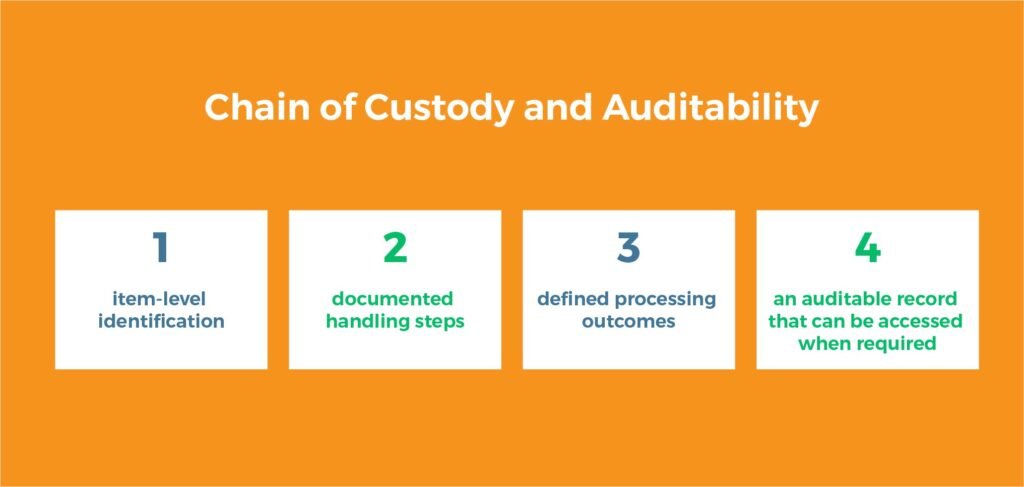
This includes:
- item-level identification
- documented handling steps
- defined processing outcomes
- an auditable record that can be accessed if required
Chain of custody and audit trails turn what is often an opaque process into one that can be explained, evidenced and stood behind with confidence.
Managing Scale Without Increasing Burden
Airports operate at scale. Managing electronic lost property internally across multiple locations can place unnecessary pressure on operational and IT teams, increasing the risk of inconsistency and human error.
By using a specialist electronic lost property service, airports can apply consistent standards across all sites while reducing internal handling. The complexity is outsourced, but visibility and accountability are retained.
Protecting Public Trust
Airports operate in highly visible, reputationally sensitive environments. Passengers expect professionalism and care, particularly where personal belongings and data are concerned.
Being able to demonstrate that unclaimed electronic devices are managed lawfully, responsibly and with full auditability supports public trust and protects the airport if concerns are raised.
Conclusion
The lawful disposal of electronic lost property is not an optional extra for airports. It is a governance requirement that sits at the intersection of data protection, operational control and public trust.
Airports that implement a documented, auditable approach to managing unclaimed electronic devices move from managing risk informally to demonstrating due diligence with confidence.